
Turning

Ready to get started with Huyett? Fill out our Custom Parts form today!
Let's Get Customizing!Advantages of Swiss Turn Manufacturing
Greater Precision means less machining time and more consistent product
Simultaneous Machining Processes means shorter lead times for you
More Accurate Estimates means more reliable quoting
With Huyett, you get...
Quick quoting and knowledgeable engineering support
Pre-production samples available
Short production lead times
PPAPs available
Minimized material waste and cycle times
Repeatability on re-orders
Wide selection of materials; over 1.5 million lbs. of steels, stainless steels, and alloys in stock
Multi-turret tool positions for milling, tapping, drilling, slotting, threading, knurling, end slits, hex heads, and more on both ends
WANT TO SEE OUR LATHE IN ACTION?
CAPACITY

Max Bar Diameter: 32 mm (1.26 inc)
Min Turning Diameter: 3 mm (0.125 in.)

PERFECT PER PRINT PARTS

Ready to get started with Huyett? Fill out our Custom Parts form today!
Let's Get Started!Turning Process
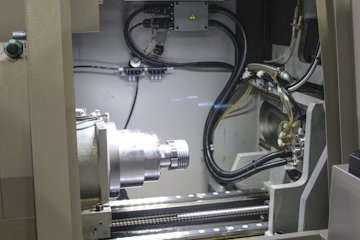
Turning is a machining operation performed on a lathe in which a workpiece rotates at high-speeds while a fixed cutting tool removes material. Huyett uses CNC, automatic bar feed equipment, and off-line programming to increase production and minimize setup time. The most obvious use for a lathe is to manufacture pins. A lathe can turn complete parts including the formation of a head or radial grooves such as those found on a headless pin.
Some of our lathes are equipped with live tooling that consists of a second small spindle that is positioned perpendicular to the workpiece (in the same plane as the tool). Live Tooling is used to produce transverse features such as a cross hole in a pin.
Lathes have a tailstock, which interferes with the end of the workpiece opposite the turret (which holds the chuck and spins the workpiece). The tailstock provides rigidity to the workpiece to minimize chatter and deformation when the part is being cut. Chatter is an undesirable attribute because it can interrupt the contact of the tooling with the workpiece. If the cutting tool does not maintain rigid and constant contact with the workpiece, excessive chatter can bend or deform the workpiece.
Turning & Facing
Among the more basic processes of a lathe are turning and facing. Turning is a material-removal process where the tool is primarily parallel to the workpiece rotation. With facing, the tool is located at a right angle to the turret.
Parting & Grooving
Parting and grooving are other common lathe processes. Parting is a turning operation that uses a single-point cutoff tool to sever a section of a workpiece from raw stock. Grooving works similarly except the workpiece is not severed. There are many different groove styles that can be produced by using specialized tooling.
Boring
Lathes can be used to bore tapered or cylindrical holes by using a single-point cutting tool mounted to the tailstock that moves parallel to the axis of rotation. The Tailstock can also be equipped with drilling or reaming tools to create holes in the axis at one end of (or all the way through) a part. All drilling and reaming performed on Huyett lathes is done using a multi-station tool turret.

Swiss Lathe Success Stories
Consolidate Your Supply Chain – Custom Parts at Competitive Prices
Problem: A customer needed 350,000 custom clinch nuts for circuit breakers, but the print offered a challenge: the requested material was costly, hard to source, and difficult to machine.
Solution: Huyett proposed a different material, which cut costs and improved manufacturability. The customer approved, and Huyett delivered a competitive quote nearly 6% less than the customer's initial asking price. After testing sample parts, the customer placed the 350,000-piece order.
Benefits: Huyett’s Swiss lathes provided the customer with hard and soft savings by not only cutting costs but also offering an opportunity for supplier consolidation. Contact Huyett today for custom manufacturing solutions at competitive prices.


Swiss Lathes Achieve the Precision Your Application Needs
Problem: Pins used in a pump assembly in food processing kept falling out during cleaning – however, a press fit was impossible due to the tungsten material, which is brittle and prone to cracking.
Solution: Huyett’s expert team used the Swiss lathes to engineer a custom part with improved and consistent tolerances, reducing the risk of failure. Huyett continues to work with the customer to develop a permanent solution using adhesives.
Benefits: Swiss lathes achieve tighter tolerances than conventional lathes, making them perfect for precision components. Choose Huyett for precise parts and long-lasting customer support.
